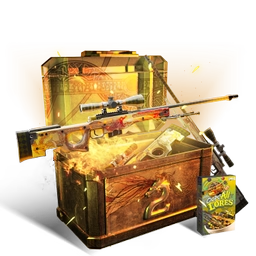
In the digital gaming ecosystem, few phenomena capture the attention of players quite like case opening. Whether it is unboxing a rare knife in Counter-Strike 2, securing a legendary weapon wrap, or collecting digital trading cards in a mobile RPG, the mechanic of opening virtual containers has become a cornerstone of modern gaming culture.
For the uninitiated, case opening may seem like a simple transaction. However, beneath the surface lies a complex intersection of probability, economics, psychology, and entertainment. This comprehensive guide explores the mechanics of case opening, why it remains so popular, and how players approach the hobby.
What is Case Opening?
Case opening refers to the mechanic where a player uses virtual currency, in-game items, or real-world money to unlock a locked digital container (often called a case, crate, box, or loot box). Upon opening, the container generates a randomized item based on pre-set drop rates.
The practice originated primarily in early free-to-play MMORPGs and exploded into mainstream consciousness with Valve’s introduction of weapon cases in Counter-Strike: Global Offensive in 2013. Since then, the mechanic has expanded across numerous game genres, spawning an entire economy of third-party marketplaces, trading sites, and dedicated streaming communities.
Common Elements of Case Opening
- The Key-and-Chest System: Most games require the purchase of two items: the container itself (often dropped for free during gameplay) and a key (bought with real-world currency).
- Rarity Tiers: Items inside cases are categorized by rarity, usually color-coded (e.g., Common, Uncommon, Rare, Mythical, Legendary/Exotic).
- Visual Animations: The reveal is rarely instant. Games use suspenseful animations—such as a spinning wheel or scrolling items—to heighten the excitement.
The Economics and Mechanics Behind the Drops
To understand case opening, one must look at how virtual economies function. Developers use drop rates to control the scarcity of digital goods. While exact odds are sometimes hidden, regulatory changes in various countries have forced many publishers to disclose the exact probabilities of receiving specific item tiers.
Below is a generalized representation of a typical case drop-rate hierarchy:
| Item Rarity Tier | Color Code | Approximate Drop Rate | Market Value Impact |
|---|---|---|---|
| Consumer / Common | Gray / Light Blue | ~79.9% | Very Low (Bulk/Recycle) |
| Industrial / Uncommon | Dark Blue | ~15.9% | Low |
| Mil-Spec / Rare | Purple | ~3.2% | Moderate |
| Restricted / Mythic | Pink | ~0.64% | High |
| Covert / Legendary | Red | ~0.13% | Very High |
| Exotic / Special | Gold / Yellow | ~0.26% (Combined) | Extremely High |
Note: Percentages vary heavily depending on the specific game, developer, and container type.
Because rare items possess actual monetary value on community marketplaces, case opening functions similarly to a lottery. Players are essentially trading a small, guaranteed amount of money for a microscopic chance at a high-value return.
The Psychology of the Drop
Why do millions of players continue to engage in case opening despite knowing the mathematical odds are against them? The answer lies in behavioral psychology.
1. The Variable-Ratio Schedule of Reinforcement
Psychologist B.F. Skinner discovered that animals (and humans) become most addicted to rewards when they are distributed on a variable-ratio schedule—meaning the reward comes after an unpredictable number of responses. Case opening is the digital embodiment of this principle. You never know if the next box will be the “jackpot,” keeping the user engaged.
2. Near Misses
Have you ever watched a case opening animation stop just one pixel short of a legendary item? This is known as a “near-miss effect.” Psychologically, near-misses trick the brain into thinking, “I was so close! I’ll get it next time,” which strongly encourages continued spending.
3. The Influence of Content Creators
Streaming platforms like Twitch and YouTube are saturated with “case opening sprees.” Influencers frequently open hundreds of cases in a single session, broadcasting their massive wins (and glossing over their quiet losses) to massive audiences. This creates a skewed perception of reality, making rare drops seem far more common than they actually are.
Best Practices and Responsible Approaches
If you choose to participate in case opening, approaching the mechanic with a clear mindset is crucial to ensure it remains an enjoyable form of entertainment rather than a financial burden.
- Set a Strict Budget: Decide beforehand how much you are willing to spend and treat that money as the cost of entertainment (similar to buying a movie ticket), not as an investment.
- Never Chase Losses: The gambler’s fallacy—the belief that a win is “due” after a series of losses—does not apply to independent random number generators (RNG).
- Buy Direct When Possible: If you have your heart set on a specific digital item, purchasing it directly from a community marketplace is almost always cheaper than trying to unbox it yourself.
- Understand the Terms of Service: Be aware of your game’s rules regarding trading, selling, and third-party gambling sites to avoid account bans or scams.
Frequently Asked Questions (FAQ)
Are case openings rigged?
Generally, no. Most reputable game developers use certified Random Number Generators (RNG) with fixed, transparent odds. The house always retains a mathematical advantage, meaning the average return value of a case is lower than its purchase price, but the outcomes are genuinely randomized.
Can I make money from case opening?
While it is technically possible to pull a rare item worth hundreds or thousands of dollars, relying on case opening as a source of income is statistically unsound. For the vast majority of participants, opening cases results in a net financial loss.
What is the difference between loot boxes and case openings?
While the terms are often used interchangeably, “loot boxes” typically refer to randomized items used within a closed game loop (sometimes containing gameplay-altering items). “Case openings” more specifically refers to cosmetic-only containers that can be traded or sold on open peer-to-peer marketplaces.
Are case openings considered gambling?
This is a subject of ongoing legal debate worldwide. Because virtual items hold real-world monetary value in secondary markets, several countries have classified certain forms of loot boxes and case openings as a form of gambling, leading to strict regulations or outright bans in regions like Belgium and the Netherlands.
Case opening remains a fascinating blend of gaming, economics, and human psychology. For some, it is an exciting way to support developers and customize their in-game experience; for others, it is an engaging spectator sport. By understanding the underlying probabilities, recognizing the psychological triggers at play, and maintaining strict financial boundaries, players can enjoy the thrill of the unboxing without falling into financial pitfalls.
Discover CS2Skin, your destination for CS2 Case excitement with CS2 skin showcases, transparent odds, and engaging features.